
Threshold Academy Substack
Origin Story


THRESHOLD ACADEMY
This substack will usually be a place for work by teachers and students at Threshold Academy: poems, prompts, notes on pedagogy, sample assignments, and to announce new course offerings, but I thought I would kick it off with an origin story and some of my hope and dreams for Threshold Academy as it starts to grow.
I have always loved to learn but for the most part I’ve often hated school. My joke-that-is-not-a-joke is that I have have dropped out of everything from preschool to grad school, but (perhaps perversely), my first impulse after making a break with formal academia was to hang out my shingle and teach. I come by it honestly! Both of my parents are teachers (now retired and almost retired), so there is an aspect of osmotic intergenerational transmission, but I also just love relational work—what I describe in an interview with my friend Amy as, “…the social field as a space of composition.”
I also had the good fortune, as I was gritting my teeth and trying to make it through high school, to be initiated into poetry by Hoa Nguyen, Dale Smith, and the community of writers and artists of which they were a part during their tenure in Austin, Texas. This is a something I talk about a lot, but that’s because it was and is so important to what came next. They showed that you didn’t need permission or lots of money: you could teach classes and host readings in your living room, you could print and staple zines there, too.
And classes could be as simple as gathering a group of people to read through a text together—even a big or daunting one (the expression many hands, light work holds true for reading, too) and doing some writing exercises (playfully, with low stakes). Classes outside of academia can also welcome forms of inquiry that are not “evidence-based,” as sources of knowledge but which have a long history, like divination.
Much of the education that has been most important to my life has happened informally, interpersonally, and non-hierarchically. In addition to Hoa’s living room workshops, I also found this model, with some variations, in the free school classes and living room reading groups of the Bay Area and, more recently, in the approach of School of the Alternative, which “aims to provide a learning space that is equitable and caring and radical in response to a world that is not.”
I should admit at this point that I didn’t drop out of grad school out of some kind of high-minded idealism, it was affecting my mental health, which was affecting my physical health. It's no surprise that one of the books that comforted me and catalyzed my turn to teaching was Azareen van der Vliet Oloomi’s Call Me Zebra. Oloomi depicted a character in the midst of breaking down, but my perspective at the time was mutually intelligible, and Zebra had something I didn’t, fire, which powered both her holy trinity of anarchism, atheism, and autodidacticism and her concept of the pyramid of exile.
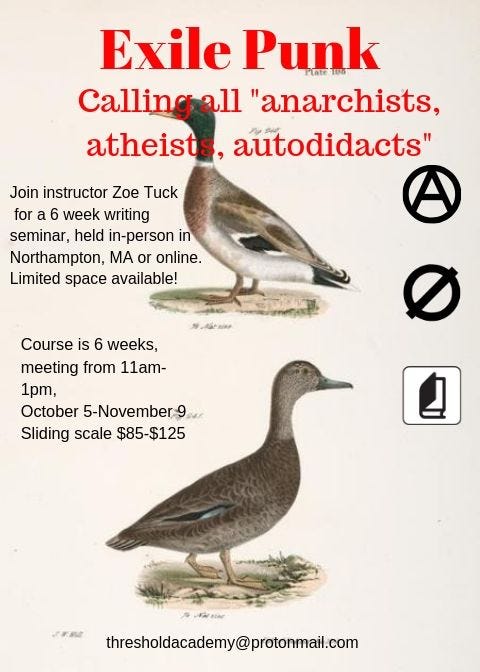
What would happen if education didn’t drive people out for being mad or sick? To say nothing of driving them mad and making them sick. What if a school could be a site of diasporic intimacy and queer inquiry?
During the time after I left grad school (2019), I met Cassidy Younghans, a Self-Directed Education advocate and facilitator who was traveling the country researching alternative educational models. She asked if I had ever been to North Star, a local site of self-directed learning for teens. When I visited, the director asked me, “What’s your school trauma?” Not, “Do you have school trauma?” but “What is it?” The implication being that of course I did. Of course, I do. Class differences, early stirrings of trans self-awareness, undiagnosed neurodivergence, and simply the pain of lacking agency within a structure that feels inescapable.
Returning to School of the Alternative’s emphasis on care, it sounds benign enough until you stop to think that centering care is anathema to the contemporary university system which lures students to take on crushing debt and which relies on a system of pedagogical peonage in which the vast majority of the teaching load falls on adjuncts, most of whom can never expect to enter the tenure track. Add to this the repression of student dissent and the university as an instrument of financial capitalism and what you have is a vast (though faltering) machine for the management of populations, not a space for the care and cultivation of souls.
Of course, this machine has its undercommons, stirringly represented by Fred Moten and Stefano Harney in their eponymous manifesto, but in addition to the good work of people trying to make lives, make change, and make a difference inside it, I perceive a need to create alternate structures. To model another way of doing it as a practice of prefigurative politics.
What I have been doing so far is not exactly that, because I’ve mainly been teaching and facilitating on my own. In itself this is nothing particularly novel or interesting. Anecdotally it’s on the rise in part, I assume, as a manifestation of what gets called the gig economy. We’re all trying to figure out how to make money, and in my corner of the literary world, this often means teaching. The private workshop is in a sense simply the other side of adjuncting—until it becomes collective.
Even now, Threshold is in a kind of transitional phase. I’m opening the gates and whoever wants to teach can, but I have hopes. I would love to create alternatives to MFA programs and PhD programs that exist for the love of learning and community without dangling the carrot of (illusory) employment and status. I would love to keep the ritual of your community celebrating your work and achievement but chuck the degree and the debt. I would love to acknowledge and face head on the urgent question of how to make a living in the arts while also holding the end of capitalism as a goal.
There’s another side to this, too. Some of the utopian projects I’ve been involved in have faltered in the execution: scarcity of funds, personality clashes, or distance between their stated ideals and their evident working principles. I don’t want to create a utopian space, so much as something collaborative, rooted in friendship and curiosity, respectful, and brave—striving towards some of the ideals and on guard against some of the issues mentioned above. I don’t expect that anyone teaching through Threshold to share the same history or preoccupations. This will be our school and whatever it becomes will come to be in the space between us.
 | A guest post by
|